Search This Blog

Thursday, 17 September 2015

"Qualitative and Quantitative Analysis of Solar hydrogen Generation Lit" by Mohammadreza Maghami, et al.


Qualitative and Quantitative Analysis of Solar hydrogen Generation Literature From 2001 to 2014

Mohammadreza Maghami

Shahin Navabi Asl

Mohamad ismail Rezadad

Nader Ale Ebrahim, Department of Engineering Design and Manufacture, Faculty of Engineering, University of Malaya

Chandima Gomes

Abstract

Solar hydrogen generation is one of the new topics in the field of
renewable energy. Recently, the rate of investigation about hydrogen
generation is growing dramatically in many countries. Many studies have
been done about hydrogen generation from natural resources such as wind,
solar, coal etc. In this work we evaluated global scientific production
of solar hydrogen generation papers from 2001 to 2014 in any journal of
all the subject categories of the Science Citation Index compiled by
Institute for Scientific Information (ISI), Philadelphia, USA. Solar
hydrogen generation was used as keywords to search the parts of titles,
abstracts, or keywords. The published output analysis showed that
hydrogen generation from the sun research steadily increased over the
past 14 years and the annual paper production in 2013 was about three
times 2010-paper production. The number of papers considered in this
research is 141 which have been published from 2001 to this date. There
are clear distinctions among author keywords used in publications from
the five most high-publishing countries such as USA, China, Australia,
Germany and India in solar hydrogen studies. In order to evaluate this
work quantitative and qualitative analysis methods were used to the
development of global scientific production in a specific research
field. The analytical results eventually provide several key findings
and consider the overview hydrogen production according to the solar
hydrogen generation.


Suggested Citation

Mohammadreza Maghami, Shahin Navabi Asl, Mohamad ismail Rezadad, Nader
Ale Ebrahim, and Chandima Gomes. "Qualitative and Quantitative Analysis
of Solar hydrogen Generation Literature From 2001 to 2014" Scientometrics (2015).


Available at: http://works.bepress.com/aleebrahim/103


"Qualitative and Quantitative Analysis of Solar hydrogen Generation Lit" by Mohammadreza Maghami, et al.

Scopus - Document details

 Export


Volume 31, Issue 5, 1 September 2015, Pages 1693-1708

Virtual R&D project teams: From E-leadership to performance  (Article)


IPAG Business School, IPAG LAB, CRET-LOG, Aix-Marseille Université, France


IPAG Business School, IPAG LAB, Paris, France


Abstract

Recent research on
virtual teams highlights the importance of high quality relationships to
achieve high team performance. For research and development (R&D)
virtual project teams, relationships characterized by cooperation and
trust are expected to enhance creativity and innovation among team
members. The purpose of this paper is to identify variables enabling
high quality relationship building in virtual R&D teams and to
analyze their influence on team performance. To this end, this study
examines the effects of leadership, work organization and communication
practices on the quality of the relationship between team members. The
theoretical developments are illustrated through a case study of a car
development project in a leading French car-making firm, PSA. Our
findings show that dynamic and positive leadership plays an important
role in enhancing relationships between team members. The results also
highlight the importance of synchronous meetings and frequent and
regular interaction to build cooperative and trusty relationships
leading to high performance. © 2015, CIBER Institute. All rights
reserved.

Author keywords

Car Industry; E-Leadership; Performance; Virtual R&D project teams


ISSN: 08927626
Source Type: Journal
Original language: English

Document Type: Article
Publisher: CIBER Institute


View in search results format


References
(66)


Ale Ebrahim, N., Abdul Rashid, S.H., Ahmed, S., Taha, Z.


(2011) Industrial Engineering and Management Systems, 10 (2), pp. 109-114. Cited 2 times.

Scopus - Document details

Saturday, 12 September 2015

Qualitative and quantitative analysis of solar hydrogen generation literature from 2001 to 2014 - Online First - Springer


Scientometrics


First online:

Qualitative and quantitative analysis of solar hydrogen generation literature from 2001 to 2014

  • Mohammad Reza Maghami 
  • , Shahin navabi asl
  • , Mohammad esmaeil Rezadad
  • , Nader Ale Ebrahim
  • , Chandima Gomes


$39.95 / €34.95 / £29.95 *
* Final gross prices may vary according to local VAT.

Get Access


Abstract

Solar hydrogen
generation is one of the new topics in the field of renewable energy.
Recently, the rate of investigation about hydrogen generation is growing
dramatically in many countries. Many studies have been done about
hydrogen generation from natural resources such as wind, solar, coal
etc. In this work we evaluated global scientific production of solar
hydrogen generation papers from 2001 to 2014 in any journal of all the
subject categories of the Science Citation Index compiled by Institute
for Scientific Information (ISI), Philadelphia, USA. Solar hydrogen
generation was used as keywords to search the parts of titles,
abstracts, or keywords. The published output analysis showed that
hydrogen generation from the sun research steadily increased over the
past 14 years and the annual paper production in 2013 was about three
times 2010-paper production. The number of papers considered in this
research is 141 which have been published from 2001 to this date. There
are clear distinctions among author keywords used in publications from
the five most high-publishing countries such as USA, China, Australia,
Germany and India in solar hydrogen studies. In order to evaluate this
work quantitative and qualitative analysis methods were used to the
development of global scientific production in a specific research
field. The analytical results eventually provide several key findings
and consider the overview hydrogen production according to the solar
hydrogen generation.

Keywords

Solar hydrogen generation
Hydrogen generation
Water splitting
Hydrogen literature


Qualitative and quantitative analysis of solar hydrogen generation literature from 2001 to 2014 - Online First - Springer

Thursday, 10 September 2015

SSRN Top Downloads For Built Environment eJournal - SSRN Top Downloads - RECENT TOP PAPERS for all papers first announced in the last 60 days 12 Jul 2015 through 10 Sep 2015


100 Most Cited Articles in Urban Green and Open Spaces: A Bibliometric Analysis


Mehdi Rakhshandehroo,


Mohd Johari Mohd Yusof,


Nader Ale Ebrahim,


Ali Sharghi and


Roozbeh Arabi


University Putra Malaysia, University Putra
Malaysia, University of Malaya (UM) - Department of Engineering Design
and Manufacture, Faculty of EngineeringUniversity of Malaya (UM) -
Research Support Unit, Centre of Research Services, Institute of
Research Management and Monitoring (IPPP), Shahid Rajaee Teacher
Training University (SRTTU) and University Putra Malaysia


Date posted to database: 15 Aug 2015


Last Revised: 15 Aug 2015


SSRN Top Downloads

Sunday, 16 August 2015

Revista Portuguesa de Imunoalergologia - Para além do fator de impacto: O artigo científico e a disseminação de conhecimento em Medicina


Revista Portuguesa de Imunoalergologia

versão impressa ISSN 0871-9721

Rev Port Imunoalergologia vol.23 no.2 Lisboa jun. 2015


EDITORIAL


Para além do fator de impacto:  O artigo científico e a disseminação de conhecimento em Medicina


João Fonseca


Unidade de Imunoalergologia, CUF Porto Hospital e Instituto

CINTESIS – Center for Health Technology and Services Research, Faculdade de Medicina da Universidade do Porto

Secretario‑Geral da Sociedade Portuguesa de Alergologia e Imunologia Clínica


Contacto


Uma
velha história sobre a publicação científica pode ser contada de forma
breve. Ao café, um médico diz ao outro: “Acabou de sair um artigo ótimo
que prova que nos doentes com … [escolha o leitor uma situação clínica]
é melhor … [intervenção terapêutica ou diagnóstica] do que … [outra
intervenção].”

O outro médico responde: “Isso até já a minha avó sabia!”

O primeiro médico comenta calmamente: “Foi pena a tua avó não ter publicado.”

O
artigo científico é um dos formatos de publicação de novos avanços do
conhecimento médico. Os processos de seleção editorial e de revisão por
pares são determinantes como forma mais valorizada de apresentação de
resultados de um trabalho de investigação em Medicina.

A
publicação de um artigo científico é hoje o modo mais visível e
persistente no tempo de disseminação desses resultados, tornando‑se
também uma montra dos autores e instituições que os produzem – a cereja
em cima do bolo dirão uns, os melhores bolos dirão outros.

Para
a afirmação e crescimento de uma área clínica é imprescindível uma
produção consistente e de qualidade de artigos científicos. Igualmente,
para a formação e actualização dos especialistas numa área clínica, a
preparação e realização de um trabalho publicado sob a forma de artigo é
um desafio e uma experiência educativa única.

Esta primazia
do artigo não significa que muitas outras formas de disseminação de
novo conhecimento clínico não sejam também necessárias e relevantes.
Pelo contrário as (boas) discussões entre colegas, as comunicações em
reuniões e congressos (e respetivos resumos), a divulgação em média não
especializados e em novos média ou as publicações sem revisão por pares,
como livros ou monografias, complementam e expandem as funções dos
artigos científicos.

Temos assistido a um crescimento
exponencial dos artigos científicos alimentado por fatores como o
aumento da investigação, os avanços tecnológicos ou mesmo o reforço da
importância do artigo científico. Em cerca de duas décadas passamos da
dificuldade de acesso a informação científica para a de imperiosidade de
escolha de entre a imensa quantidade de artigos científicos produzidos.

Hoje perguntamo‑nos como os procurar1
e como os selecionar. A seleção dependerá, seguramente, do motivo
porque queremos ler mas, de um modo geral, será seguro que os artigos
mais citados por outros autores terão um maior interesse. No entanto, só
passado demasiado tempo sabemos que artigos são mais citados.

O que sabemos é que artigos publicados em revistas que tem artigos muito citados têm habitualmente mais citações.

Estas
revistas são as mais prestigiadas, mais procuradas para publicação e
por isso mais exigentes na escolha dos artigos que publicam. Por
consequência, os artigos aí publicados tendem a ter mais qualidade e
importância, sendo por isso mais citados.

O Institute of Scientific Information(ISI) agora parte da Web of Science da Thomson Reuters, concebeu uma medida do impacto de uma revista utilizando o número de citações – o fator de impacto (FI).2
O FI contabiliza as citações feitas num dado ano a artigos publicados
nos dois anos anteriores nas revistas incluídas no Science Citation
Index, a base de dados mais exigente de indexação de revistas
científicas.

O cálculo do FI é o quociente entre o número de
citações que os artigos publicados na revista durante os dois anos
anteriores tiveram naquele ano e o número de artigos publicados – o FI
de 2014 da revista x é igual número de citações em 2014 dos artigos
publicados em 2012‑13 na revista x a dividir pelo número de artigos
publicados em 2012‑>13 na mesma revista. Simplificando poderíamos
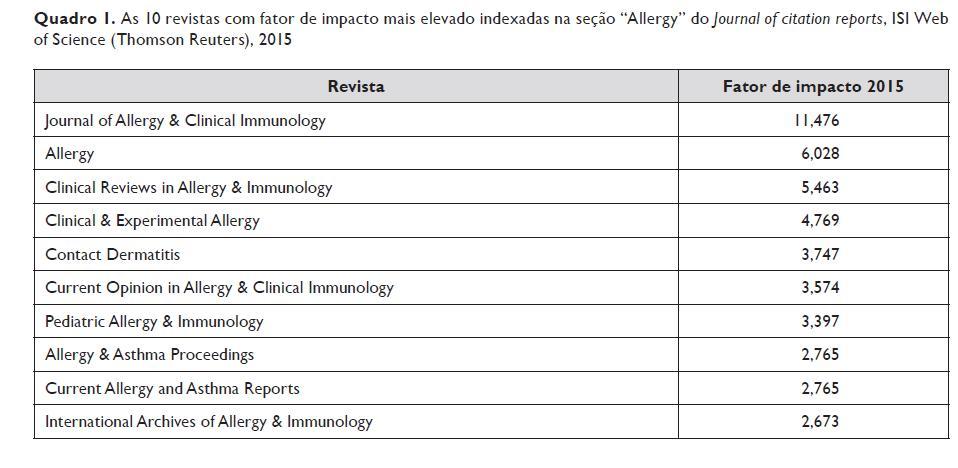
dizer que um artigo publicado na revista Allergy, por exemplo, terá em média 6 citações nos 2 anos seguintes (Quadro 1). O FI de uma revista pode ser procurado no Journal of citations reports(JCR),3
um recurso pago da Thomson Reuters, a que as instituições portuguesas
têm acesso através da biblioteca do conhecimento online (B‑on.pt). Pelo
mês de junho de cada ano são publicados os FI do ano anterior. Em 2015
foi apresentada a 40.ª edição. A categoria Allergytem 24 revistas
indexadas e o fator de impacto agregado dessas 22 revistas é 4047,
correspondendo ao 22.º lugar das 232 categorias de todas as áreas
científicas que fazem parte do JCR. No Quadro 1 estão listadas por ordem decrescente as dez revistas com maior fator de impacto indexadas na categoria Allergy do JCR em 2014.


O FI é muito utilizado por ser uma medida simples, fácil de entender e
que mostrou o seu valor o longo de várias décadas. No entanto, como não
há medidas perfeitas, têm sido feitas muitas críticas ao FI4 e à sua
utilização para fins para os quais não foi desenvolvido. O FI não pode
ser utilizado para avaliar o impacto de um artigo em concreto, mas de
uma revista científica. Provavelmente a crítica mais frequente (mas não a
mais importante) feita ao FI é a impossibilidade de ser usada para
comparar revistas de diferentes áreas científicas – o número de citações
varia muito entre áreas científicas, por exemplo pelas diferenças de
produção científica mas também pela natureza própria das áreas e hábitos
de citação. Surgiram, por isso, outras métricas mais evoluídas como o
Source Normalized Impact per Paper (SNIP) que tem em conta o
número total de citações de uma determinada área científica, o que
permite comparar revistas de áreas diferentes. Além de outras melhorias
face ao FI o SNIP é de acesso livre5 mas continua ser menos
conhecido. Já neste ano de 2015 a Thomson Reuters apresentou o percentil
de fator de impacto de uma revista, o qual normaliza o FI, permitindo a
comparação entre revistas de diferentes áreas. Existem várias outras
medidas de bibliometria, isto é, a análise estatística das publicações e
suas citações utilizadas em situações mais específicas.
Alem das medidas de bibliometria, a análise da disseminação e do
impacto que um determinado artigo tem pode hoje ser medido analisando as
referências ao artigo na Internet (webometrics). Em 2010, foi proposta uma medida mais geral do impacto dos artigos – a altmetrics,6 que além das citações incorpora o número de visualizações dos artigos, de downloads, de referências em bases de conhecimento, nos social média e média tradicionais.

Esta
medida pode ser aplicada a revistas, pessoas ou instituições, por
exemplo, concorrendo assim também o h‑index, uma métrica muito utilizada
para avaliar a produtividade e o impacto científico de um investigador
ou grupo.7 Ainda a propósito da disseminação do conhecimento
utilizando a Internet, são de referir ferramentas de comunicação
dirigida aos interesses de cada elemento de comunidades científicas e
que ajudam a conhecer os artigos que vão sendo publicados. São exemplos o
Research Gate (http://www.researchgate.net), Researcher ID http://www.researcherid.com/ ou Academia.edu https://www.academia.edu/.
Em muitos casos são também repositórios de autoarquivo dos artigos
completos pelos autores, permitindo aceder a artigos publicados em
revistas às quais não temos acesso livre.

Em resumo, o
artigo científico é o principal meio de disseminação dos avanços do
conhecimento médico. As rápidas alterações das últimas décadas tornaram
necessário aprender a pesquisar e a selecionar os artigos científicos.

O
fator de impacto foi uma das primeiras métricas utilizadas para medir o
impacto da publicação científica, é muito utilizado por ser fácil de
interpretar mas também fácil de usar de forma inapropriada. Estamos a
assistir à utilização crescente de outras medidas que nos ajudam a
compreender melhor a disseminação e o impacto de revistas e de artigos
científicos, mas também dos próprios autores e grupos/instituições.


REFERÊNCIAS

1.
Jacinto T, Morais A, Fonseca, J A. How to write a scientific paper –
Searching and Managing Biomedical information. Rev Port Pneumol
2011;17(4):190>‑4

2. The Thomson Reuters Impact factor. http://wokinfo.com/essays/impact‑factor/

3. Journal of citation reports. https://jcr.incites.thomsonreuters.com/

4. Fooladi M, Salehi H, Yunus MM, Farhadi M, Chadegani AA, Farhadi, H, et al. Does Criticisms Overcome the Praises of Journal Impact Factor?. Asian Social Science 2013; 9(5):176‑82

5. Centre for Science and Technology Studies (CWTS) Journal Indicators. http://www.journalindicators.com/

6. Priem J, Taraborelli D, Groth P, Neylon C, Altmetrics: A manifesto, 26 October 2010. http://altmetrics.org/manifesto/

7.
Jones T, Huggett S, Kamalski J. Finding a way through the scientific
literature: indexes and measures. World Neurosurg 2011; 76(1‑2):36‑8


Contacto:

João Fonseca

CUF‑Porto

Hospital e Instituto

Estrada da Circunvalação 14341

4100‑180 Porto

Todo o conteúdo deste periódico, exceto onde está identificado, está licenciado sob uma Licença Creative Commons
  Sociedade Portuguesa de Alergologia e Imunologia Clínica

Rua Manuel Rodrigues da Silva, 7 C - escritório 1
1600-503 LisboaRevista Portuguesa de Imunoalergologia - Para além do fator de impacto: O artigo científico e a disseminação de conhecimento em Medicina

Wednesday, 12 August 2015

The Impact of Customers’ Perception of CSR on Corporate Brand Loyalty: The Case of the Romanian Mobile Telecom Industry

The Impact of Customers’ Perception of CSR on Corporate Brand Loyalty: The Case of the Romanian Mobile Telecom Industry

Ovidiu-Ioan Moisescu


Central European Business Review, 2015, vol. 2015, issue 2, pages 21-30


Abstract:
The goal of the current research is to analyze the impact of customers’
perceptions of corporate social responsibility (CSR) on their loyalty
towards mobile telecommunication companies within the particular
socio-cultural and economic context of one of the largest national
markets of Central and Eastern Europe. In order to achieve this goal, a
survey was conducted among a sample of 1,464 mobile telecommunication
customers from the urban area of Romania. The findings point out the
fact that Romanian mobile telecom customers’ loyalty is not
significantly impacted by how they perceive their service suppliers’
responsibilities with regard to their employees or economic success,
while their perceptions of companies’ responsibilities towards
customers, public authorities, the environment, community development,
and sponsorship have a significant impact on corporate brand loyalty.
The findings have managerial implications in what concerns the
appropriate implementation and communication of CSR policies by mobile
telecommunication companies from the region in order for them to enhance
their customer’s loyalty.


Keywords: mobile telecommunication; customer loyalty; CSR (search for similar items in EconPapers)

JEL-codes: M31 (search for similar items in EconPapers)

Date: 2015

References: View references in EconPapers View complete reference list from CitEc
Citations Track citations by RSS feed


Downloads: (external link)
http://cebr.vse.cz/cebr/article/download/184/128
http://cebr.vse.cz/cebr/article/view/184 (text/html)

free of charge


Related works:
This item may be available elsewhere in EconPapers: Search for items with the same title.


Export reference: BibTeX
RIS (EndNote, ProCite, RefMan)
HTML/Text


Persistent link: http://EconPapers.repec.org/RePEc:prg:jnlcbr:v:2015:y:2015:i:2:id:123:p:21-30


Ordering information: This journal article can be ordered from
Faculty of Business Administration, University of Economics, Prague
http://cebr.vse.cz/cebr/
ondrej.machek@vse.cz


Access Statistics for this article

Central European Business Review is currently edited by Ing. et Ing. Ondřej Machek, Ph.D.


More articles in Central European Business Review from University of Economics, Prague
Contact information at EDIRC.
Series data maintained by Vaclav Subrta (subrta@vse.cz).


EconPapers: The Impact of Customers’ Perception of CSR on Corporate Brand Loyalty: The Case of the Romanian Mobile Telecom Industry

Virtual Teams: A Literature Review

Virtual Teams: A Literature Review


Nader Ale Ebrahim


University
of Malaya (UM) - Department of Engineering Design and Manufacture,
Faculty of Engineering; University of Malaya (UM) - Research Support
Unit, Centre of Research Services, Institute of Research Management and
Monitoring (IPPP)

Shamsuddin Ahmed


University of Malaya (UM)

Zahari Taha


University of Malaya (UM)


November 6, 2009


Australian Journal of Basic and Applied Sciences, Vol. 3, No. 3, pp. 2653-2669, 2009


Abstract:


In the competitive market, virtual teams represent a
growing response to the need for fasting time-to-market, low-cost and
rapid solutions to complex organizational problems. Virtual teams enable
organizations to pool the talents and expertise of employees and
non-employees by eliminating time and space barriers. Nowadays,
companies are heavily investing in virtual team to enhance their
performance and competitiveness. Despite virtual teams growing
prevalence, relatively little is known about this new form of team.
Hence the study offers an extensive literature review with definitions
of virtual teams and a structured analysis of the present body of
knowledge of virtual teams. First, we distinguish virtual teams from
conventional teams, different types of virtual teams to identify where
current knowledge applies. Second, we distinguish what is needed for
effective virtual team considering the people, process and technology
point of view and underlying characteristics of virtual teams and
challenges they entail. Finally, we have identified and extended 12 key
factors that need to be considered, and describes a methodology focused
on supporting virtual team working, with a new approach that has not
been specifically addressed in the existing literature and some guide
line for future research extracted.


Number of Pages in PDF File: 17


Keywords: Virtual team, Literature review, Effective virtual team


Open PDF in Browser
Download This Paper

Date posted: November 7, 2009
 

Suggested Citation

Ale
Ebrahim, Nader and Ahmed, Shamsuddin and Taha, Zahari, Virtual Teams: A
Literature Review (November 6, 2009). Australian Journal of Basic and
Applied Sciences, Vol. 3, No. 3, pp. 2653-2669, 2009. Available at SSRN:
http://ssrn.com/abstract=1501443
Virtual Teams: A Literature Review by Nader Ale Ebrahim, Shamsuddin Ahmed, Zahari Taha :: SSRN